


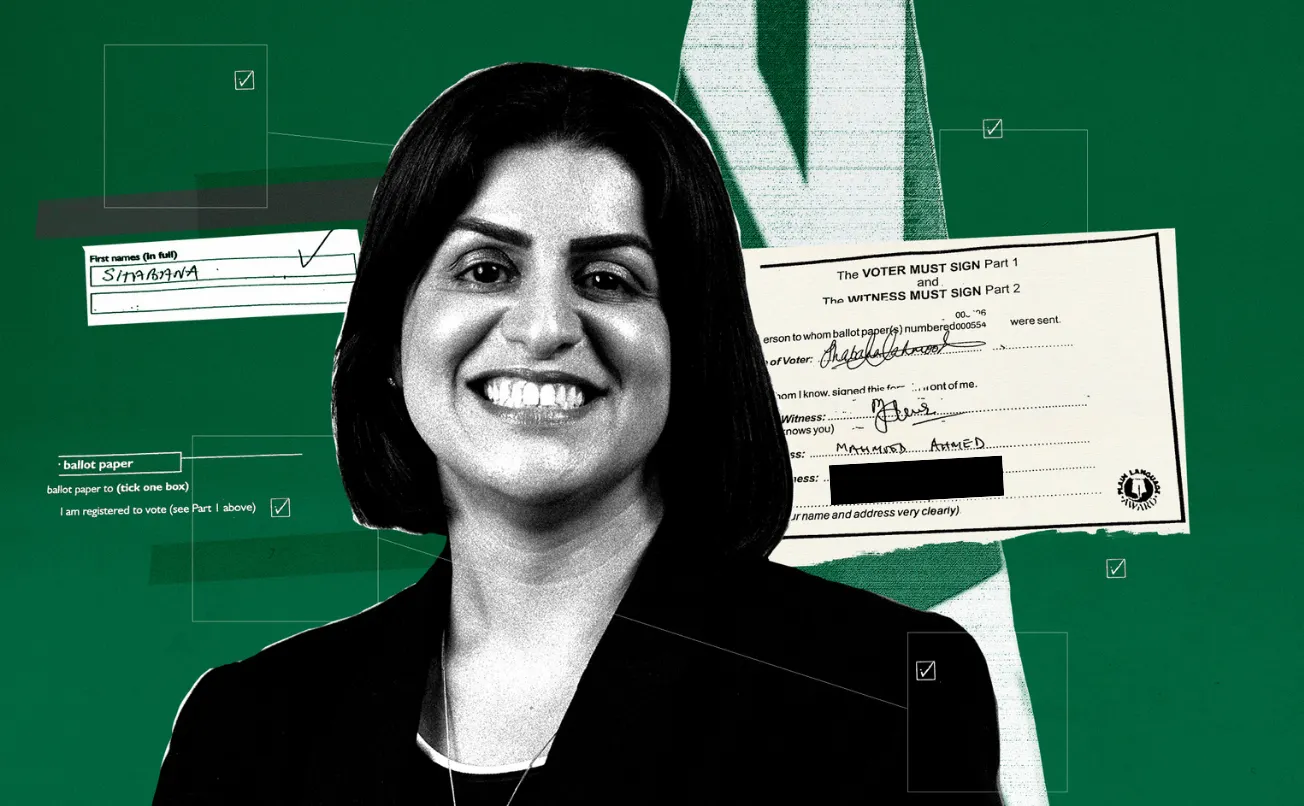
Shabana Mahmood’s postal ballot was examined in an explosive vote-rigging trial, in which the judge concluded there had been “widespread fraud” in two wards at the 2004 Birmingham city council elections. The elected candidates were required to step down and banned from office for five years.
The case turned, in part, on signatures by the same person that didn’t match, prompting allegations of ballot-tampering and fraud. The Dispatch has seen relevant documents, and can reveal that Mahmood’s signatures on her postal-vote application and the declaration of identity she submitted with her ballot appear markedly different.
Mahmood’s special adviser at the Home Office last night threatened to sue The Dispatch for defamation and breach of privacy, as well as to invoke “injunctive relief to restrain publication” when we sought comment from the home secretary. The adviser had earlier in the day explained that the discrepancy between the two documents came about because Mahmood used two different signatures at the time.
When we pushed back against the legal threats and said we were publishing the story today, a spokesperson for Shabana Mahmood said: “Shabana Mahmood signed both of these documents, which are clearly in her own handwriting. False allegations that her father signed these documents were dismissed, with no adverse finding, over twenty years ago.”
The spokesperson added: “Shabana Mahmood is a dedicated public servant, who serves Birmingham, this country, and has long championed our democracy.”
The special election court case came about after six local Labour politicians were accused of using forgery, ballot manipulation, and theft to rig thousands of votes.
Richard Mawrey KC, who presided over the case as an election commissioner, said that the evidence he had heard would “disgrace a banana republic”.
Mawrey found that “there were corrupt and illegal practices committed by the Labour Party Respondents and their agents” that likely affected the outcome of the election. Mahmood Ahmed, Shabana’s father, was Labour’s election agent in Bordesley Green, one of the two wards involved in the case. Ahmed’s role has largely escaped public notice, apart from a brief mention in a 2013 Birmingham Post report.
Ahmed also witnessed the signing of three declarations of identity, which a voter must complete to cast a postal ballot, all of which became part of the evidence in the vote-rigging case initiated by a rival party. That party had identified apparent discrepancies between the signatures on the declarations and the form used to apply for a postal vote. One of the forms he witnessed was Shabana’s — then a 24-year-old Law graduate from the University of Oxford who was training to be a barrister in London.
The spokesperson for Shabana Mahmood said it was “completely untrue” that Ahmed had signed on others’ behalf. “The matter was tested by the court, twenty years ago. Independent expert advice was provided and considered, and the allegation was dismissed with no adverse finding.”
However, Mahmood Ahmed is not named in Mawrey’s 100-page judgment, nor does Mawrey address or dismiss any allegations against him.
Justice Mawrey concluded his ruling with a question: "Is the court able to form a view as to whether corrupt practices were widespread in Birmingham in June 2004?” And an answer: “In my judgment it is.”
The six Labour councillors in Bordesley Green and Aston had their victories declared null and void, and all were banned from running for election for five years. One of the former councillors for Aston was later cleared by the Court of Appeal of being personally guilty of corrupt and illegal practices.
The judgment in the case was handed down a month before the 2005 general election, in which Tony Blair was elected as prime minister for a third term.
Nick Raynsford, then the local government minister, said at the time: “We are determined that the fraud in these cases in Birmingham does not undermine public confidence in the electoral system.” Then home secretary Charles Clarke responded to the scandal by demanding that police chiefs “crack down on electoral fraud”.
Welcome to The Dispatch! My name is Kate and I set up this newsletter in 2023 to create a home for quality, old-school reporting about Birmingham and the West Midlands.
We send out all our journalism via email, so please join up now. We promise no junk - just local journalism done properly. No card details required.
The two signatures
The postal ballots and accompanying documents — the applications and declarations of identity — had been released for the court and the petitioners to scrutinise ahead of the four-week hearing in February and March 2005. The court heard of ballots that had been robbed from postal workers and taken to an empty warehouse to be filled in. Some had been altered with Tipp-Ex. Others had been applied for without voters’ knowledge and filled in on their behalf — much to their dismay when they showed up at the polling station only to be told they had already voted.
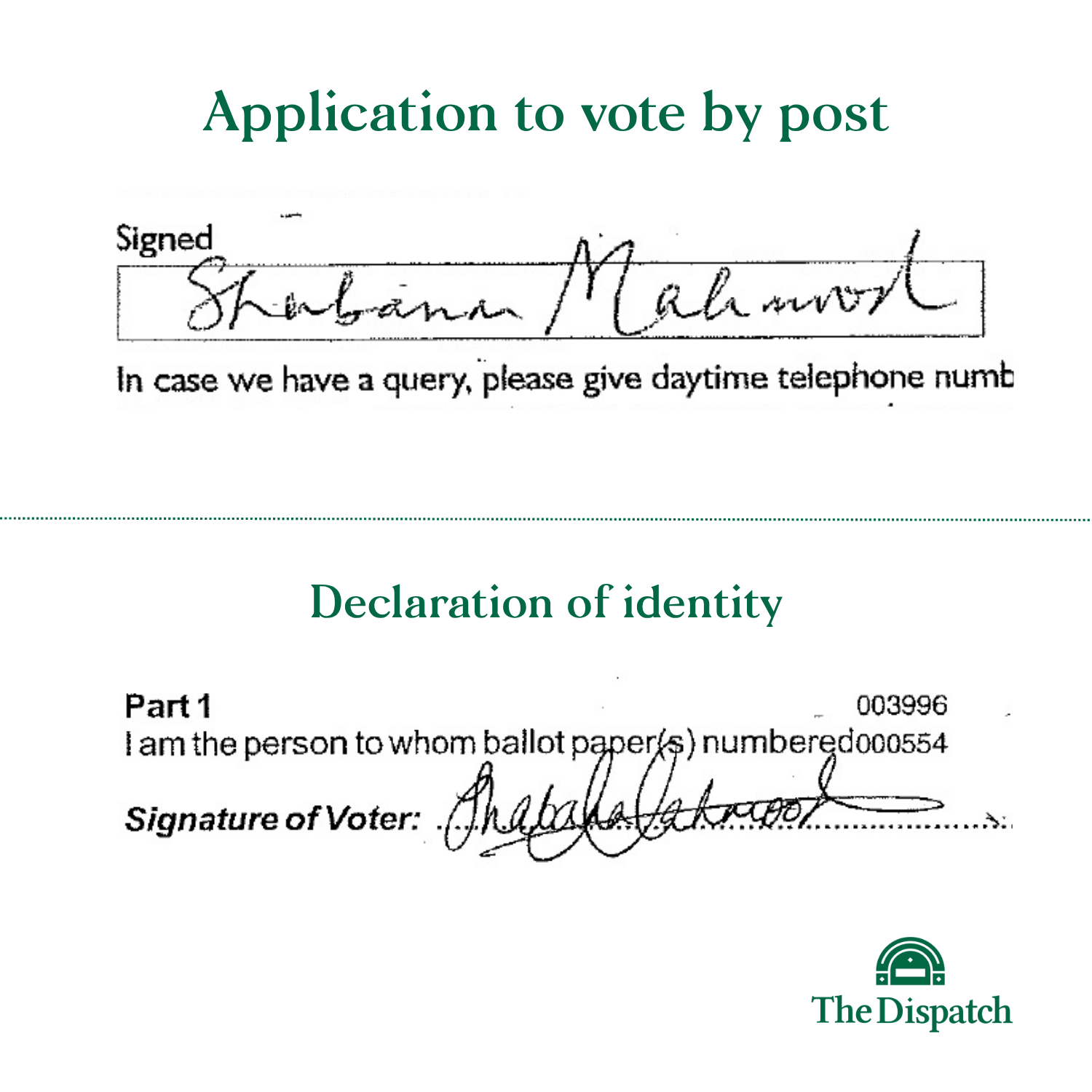
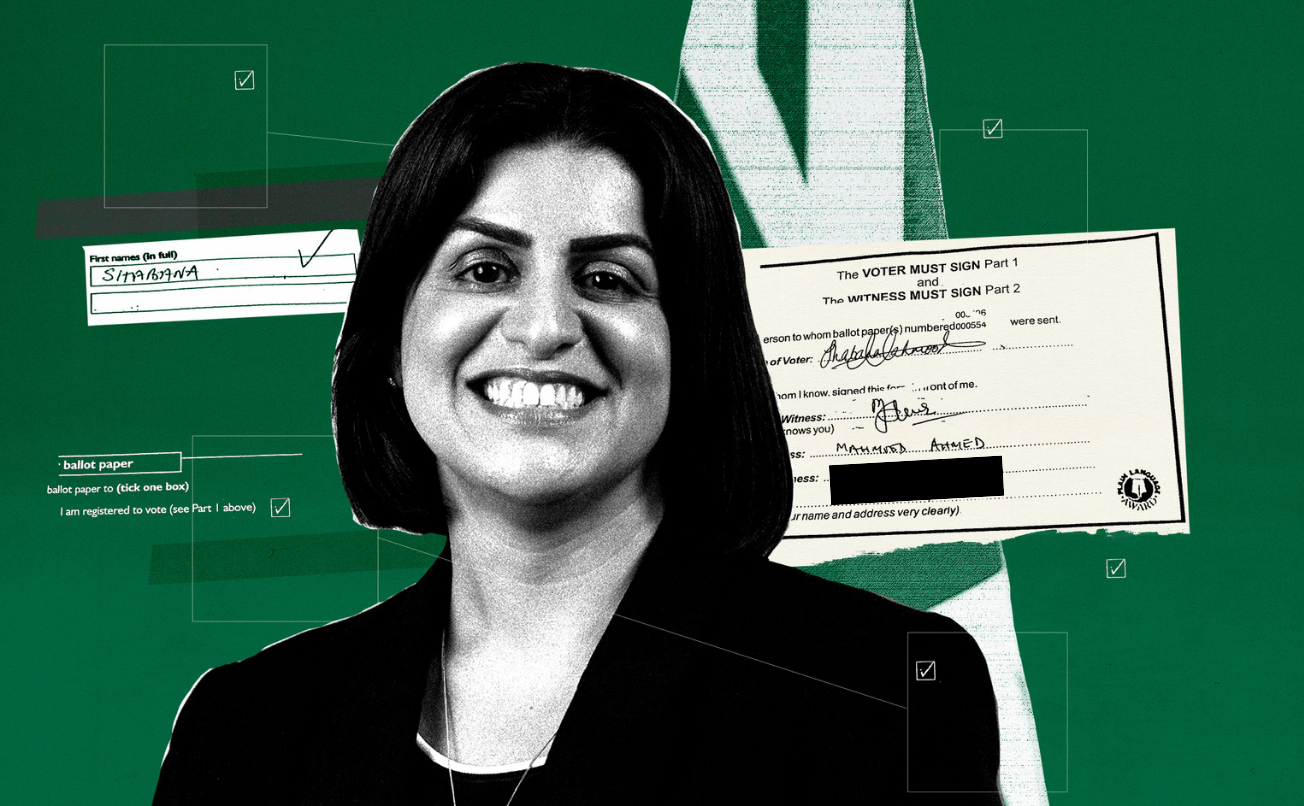
The Dispatch has obtained documents from the case, including the documents accompanying Shabana Mahmood’s postal ballot. On Shabana’s application for a postal ballot, her name is printed at the top. In the signature field at the bottom, there is a reminder that each person has to sign their own form. It also says: “It is an offence to make a false statement on this form — maximum fine £5,000.” Her name is written out in full, in a neat, curvy script.
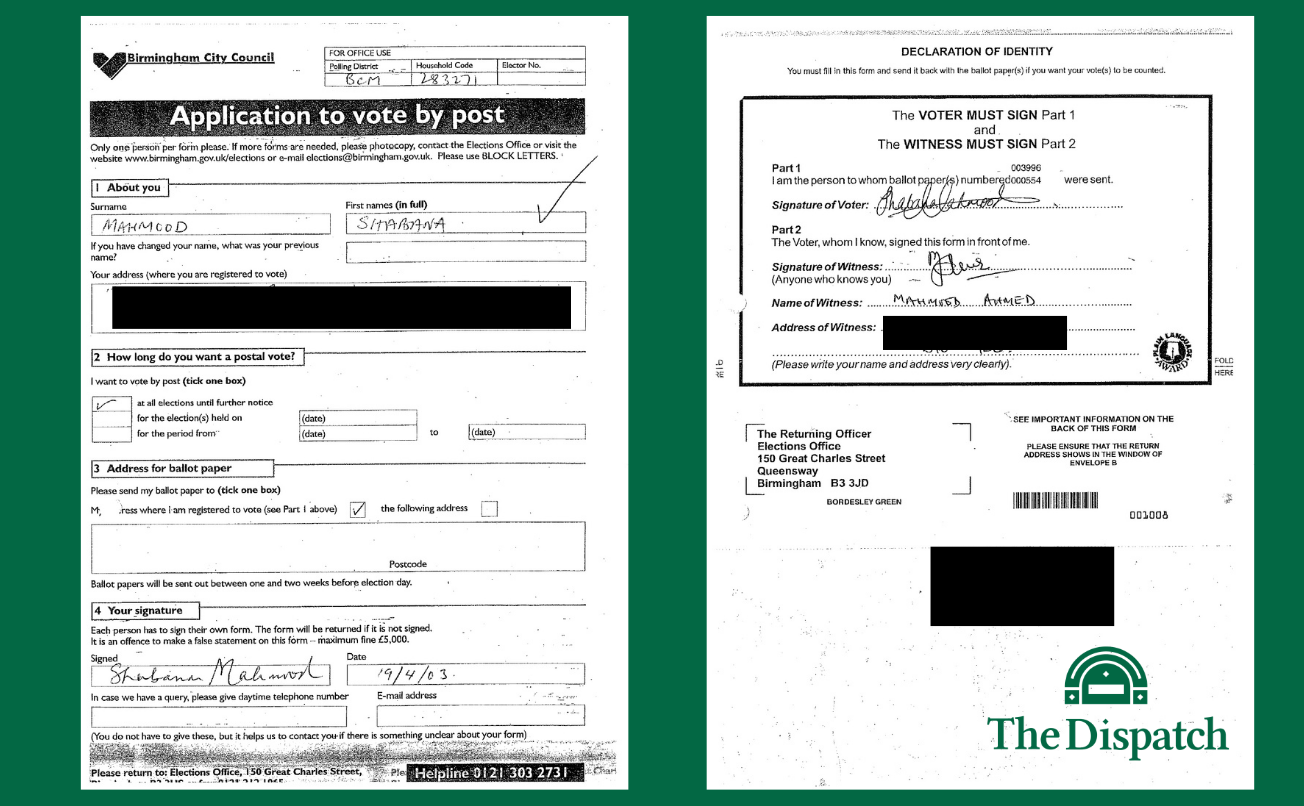
On the declaration of identity, however, her signature looks strikingly different. It is a loopy cursive, the “m” of Mahmood overlays her first name and the “d” ends with a flourish. The form is witnessed by her father, Mahmood Ahmed, then Labour’s agent in Bordesley Green and later the chairman of the Birmingham Labour Party.
You can see the two signatures in the image below — the first is from the ballot application, and the second is from the declaration of identity form that accompanied the ballot.
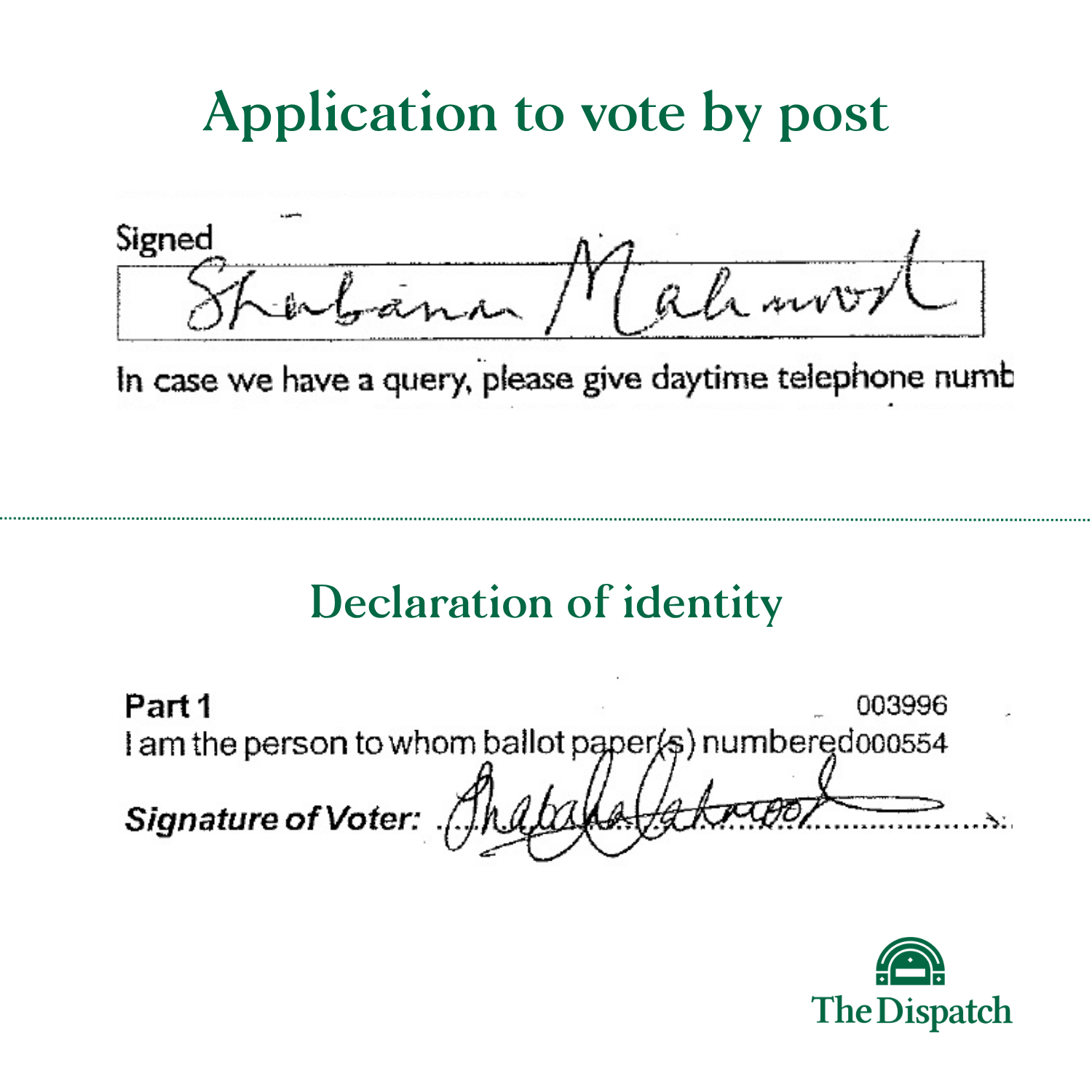
When we asked Mahmood about this discrepancy, her spokesperson did not deny that the signatures were unlike each other, but said that Mahmood used two different signatures at the time. When we asked several times why she would use a different signature for a document that exists to verify her identity based on the ballot application, they did not provide an explanation.
Last night, Mahmood’s spokesperson said in a statement: “Shabana Mahmood signed both of these documents, which are clearly in her own handwriting. False allegations that her father signed these documents were dismissed, with no adverse finding, over twenty years ago.”
The ‘schedule’
The special election court looked at irregularities in Aston and Bordesley Green. Three Labour councillors had been elected in each constituency, but in both cases, they had been accused of vote-rigging by rival parties. The Liberal Democrats had brought the case against the Aston candidates. In Bordesley Green, it was the People’s Justice Party (PJP) who claimed foul play.
In the Bordesley Green case, PJP members and supporters had accused the elected councillors Shafaq Ahmed, Shah Jahan and Ayaz Khan of electoral fraud. The petitioners had analysed the postal vote applications and the declarations of identity that had been signed by voters, witnessed, and submitted to the council alongside their ballots.
The volunteers matched them up and recorded any irregularities, including if the signatures did not appear to match. Barbara Holland, who was and remains a member of the Labour party, was responsible for compiling all of the evidence from the analysis of the papers into a large spreadsheet which she printed into a book and called the “schedule”.
In his judgment, Justice Mawrey examined “fifteen types of fraud” in Bordesley Green. “Evidence established that over 1,600 postal votes were cast in favour of the Labour Party candidates in which the signature of the [voter] set out on the declaration of identity differed from the signature Page for that [voter] set out on the application for a postal vote submitted in their name,” he wrote.
He said his finding was confirmed by reports of handwriting analyst Micheal John Allen, who analysed 201 sets of documents with apparently mismatched signatures, and by Holland’s schedule. Mahmood's papers were not part of the sample Allen looked at, but their discrepancies were recorded in Holland’s comprehensive schedule.
Welcome to The Dispatch. We’re Birmingham's new newspaper, delivered entirely by email. Sign up to our mailing list and get two totally free editions of The Dispatch every week: a Monday briefing, full of everything you need to know about that’s going on in the city; and an in-depth weekend piece like the one you're currently reading.
No ads, no gimmicks: just click the button below and get our unique brand of local journalism straight to your inbox.
Holland was also questioned at the trial. Mawrey wrote: “Ms Holland gave evidence before me and impressed me as a careful and thorough lady whose approach had been, as I say, cautious throughout. I am entitled, therefore, to place considerable reliance on Ms Holland's evidence and I do.”
Holland and other volunteers also compiled a list of names that cropped up repeatedly, something they deemed to be suspicious. “Top of the list was the election agent for the Labour party” in Bordesley Green, she told The Dispatch, referring to Mahmood Ahmed. “Because he was the agent and should have had oversight of the campaign.”
Holland and her husband Raghib Ahsan have kept the documents from the case and provided Shabana Mahmood’s records to The Dispatch because they are concerned with her recent efforts to restrict migrants’ rights. “She has recently made statements that have concerned us, and one is that she has put forward her own family as an example of migrants being involved in the local communities and she wants that now to be a requirement for people who want leave to remain and citizenship,” says Holland. “And I think nobody has taken a look at, well, what is the record of Shabana's family?”
Five years after the vote-rigging case, Shabana Mahmood was elected as the Labour MP for Birmingham Ladywood, which includes both wards in which the fraud had taken place. Since Labour re-entered government two years ago, Mahmood has risen quickly, first serving as justice secretary and then being appointed home secretary in September last year. As home secretary, she oversees policing and the prevention of crime across the country and in her speech to the Labour conference last September, she pledged to “get tough and tackle crime” from violent crime to shoplifting. She recently launched the government’s new Fraud Strategy. Mahmood said that fraud “undermines public trust” and sent a “clear message” to criminals that there is “nowhere you can hide.”
The legal threats
Just before 7pm last night, Shabana Mahmood’s special adviser Joshua Williams sent us a three-page letter threatening us with a series of lawsuits if we published our story about the home secretary. The letter demanded that we promise by 9pm that we would not publish any article that names “any member of the Home Secretary’s family” or that implies that any member of the Mahmood family engaged in electoral fraud.
The threat was explicit: “If we do not receive that confirmation by 9pm today, or if you publish in breach of this notice, we reserve the right to issue proceedings for defamation and misuse of private information,” Williams wrote, adding: “We expressly reserve the right to apply for injunctive relief to restrain publication.”
Williams also wrote that the Home Office “will be examining the lawful basis” on which we hold information relating to this story, suggesting that the government plans to investigate The Dispatch purely for reporting on the family and therefore “processing their personal data in connection with these allegations”. His letter was signed: “Special Adviser to the Home Secretary”.
The letter was marked Private and Confidential, but we are choosing to quote it here because of how highly unusual it is for a senior adviser on the government’s payroll to attempt to intimidate journalists in this way. It’s normal for an adviser to ask for certain personal details not to appear in a story and for us to agree to those requests, as happened in this case. But we have never been sent a letter by a government employee threatening injunctions and lawsuits in defamation and privacy, and it is unclear on which lawful basis these threats were meant and who would file them.
The Dispatch believes there is a clear public interest in reporting on documents signed by the now home secretary which formed part of a notorious elections trial.
We replied to the letter just before 10pm last night, confirming that we would be publishing our story and pushing once again for an explanation of the handwriting discrepancy. We also asked whether the home secretary knew in advance about the legal threats being sent by her adviser Williams, who served as the director of strategy at the lobby group Labour Together before he entered government.
Just after midnight, Williams wrote to us again, this time from his personal email rather than his government account, clarifying that all of his correspondence had been from him as an adviser to Mahmood and not on behalf of the Home Office. He did not repeat any of his legal threats.
We will be publishing a more in-depth feature about this story for paying Dispatch members tomorrow. That piece will reveal new details about the Mahmood family’s connection to the vote-rigging scandal. If you know something about this story, please get in touch with Kate.
There's more to come: on Sunday we are publishing Part Two of this story. That piece will reveal new details about the Mahmood family’s connection to the vote-rigging scandal and will be for paying members only.
By becoming a member, you will also be supporting our investigative journalism and helping us to stand up to the kind of legal threats we got last night from the government.
Comments